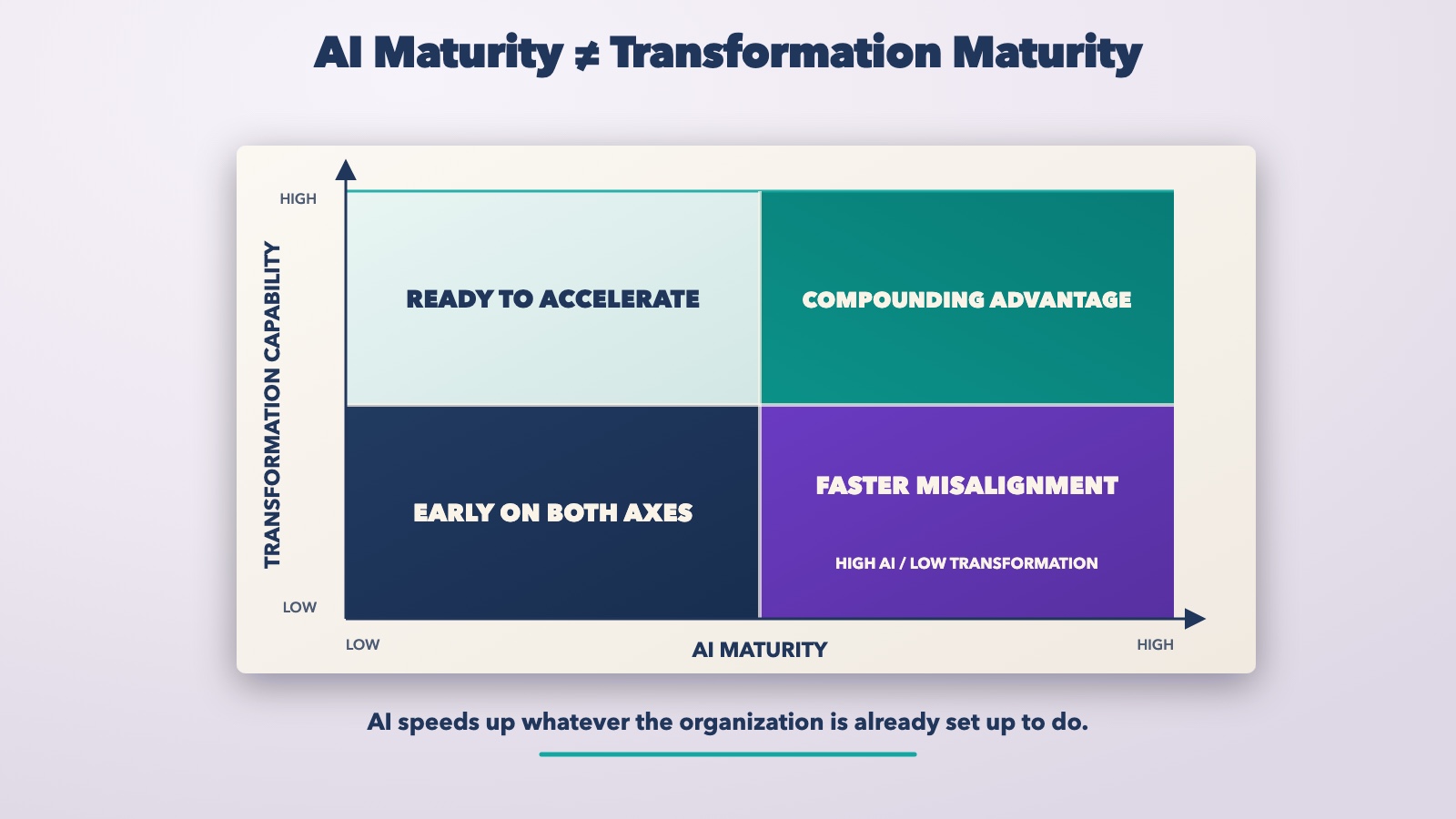
Your team can now produce in an afternoon the analysis that used to take a week. That is a real change; but before you count the full benefit, follow that analysis to the next person. Who decides which recommendations deserve attention? Who checks the underlying assumptions? Who changes the process, coordinates the affected teams, and finds out whether the change worked? Without answers, an AI time saving can become somebody else's unplanned workload.
My argument is that leaders need to plan for the work AI creates alongside the work it removes. When the supply of analyses, recommendations, and possible improvements expands, the organization needs a deliberate way to decide what deserves further effort, and the capacity to carry those choices through. Otherwise, a team can become much better at producing opportunities while the rest of the organization struggles to use them.
A Larger Supply of Possibilities
On October 6, 2026, OpenAI released mathematical work produced by an internal model. As of October 9, its repository lists 719 manuscripts in 372 related families. It says plainly that the collection contains results at different stages of verification, with some proofs formalized in Lean (a language that lets a computer check a proof) and possible issues in results that have not been formalized. Those counts describe manuscripts at different stages of checking; they don't tell you how many are independently established breakthroughs (OpenAI: math repository on GitHub).
OpenAI also says it will fund workshops, conferences, and programs to help people understand major AI-produced results. The release therefore acknowledges that making work available and enabling others to understand it are separate undertakings (OpenAI: Sharing AI progress in mathematics, October 6, 2026).
There is a business question here even if you never read a mathematical proof: what happens when producing potentially useful work becomes easier than incorporating it into what people do next? The release doesn’t establish that companies are experiencing this problem, or how often. It gives us a concrete reason to examine a possibility that deserves a place in the design of AI-enabled work.
Follow the Output into the Organization
Consider a hypothetical customer service organization. An AI system reviews complaints and generates suggestions for improving the customer experience. The service team welcomes the additional coverage because it can now turn attention to issues that previously received too little focus. Some recommendations concern product instructions. Others involve billing, fulfillment, or the terms customers were promised during the sale. Each may be reasonable, but each also creates work for someone beyond the team that produced it.
Product managers need to establish whether the suggested change addresses a recurring problem, Finance may need to examine a proposed billing adjustment, and Operations must determine whether a delivery change is feasible. Someone has to weigh the recommendations against commitments already in progress. If the pilot measures only the time saved analyzing complaints, much of that work stays outside the reported result. The analysis team has gained capacity; the organization may have acquired a queue.
That queue may even be a good sign since it might contain valuable opportunities the company previously could not see. The important question is whether leadership has made a conscious choice about how much of that opportunity to pursue, in what order, and with whose time.
A recommendation can be accurate and relevant while still being the wrong thing to implement this month. Another may be less impressive on paper but remove an immediate obstacle for customers. Deciding between them requires context about the whole business.
Account for the Work After Generation
I would ask the pilot team to trace one output from its creation to a useful result. At each handoff, identify what the receiving person must do and whether they have room to do it.
There may be work required to remove duplicates, check evidence, consult affected people, resolve competing priorities, run a small trial, or update an established process. Some of that work can also be assisted or automated. Some can be eliminated by giving the system better context before it starts.
For example, the complaint-analysis system could receive the company's current priorities, known constraints, and changes already underway. It could group similar recommendations and explain which customer problem each addresses. That would reduce the burden of making sense of its output.
Those improvements still leave an operating choice: how many changes can this organization responsibly pursue at once? The answer should influence what the system produces, how frequently it produces it, and what gets routed to people. An instruction to generate every possible improvement may be useful during exploration. It becomes less useful as a standing assignment when nobody has designed what happens to the results.
This is also an incentive question. If the originating team receives credit for the number of recommendations delivered, while receiving teams are judged solely on existing commitments, the organization has created a conflict. Asking everyone to collaborate harder leaves that conflict intact.
Capability Needs Conditions to Become Useful
The World Bank's October 6, 2026 India Development Update offers a related point at a different scale. Its official summary describes growing AI investment while emphasizing infrastructure, broader access, workforce capacity, and the business environment. It also acknowledges that AI's long-term economic and labor-market effects remain uncertain. This is country-level analysis and policy guidance; it doesn't tell us whether a particular company will earn a return from a particular organizational change (World Bank: India Development Update, October 2026).
My interpretation is that leaders should take the complementary work seriously. Having access to a capability does not settle how its benefits will be realized. Within a company, that means examining the people, resources, and operating arrangements that connect a new capability to a result. A promising tool may need a different meeting rhythm, a clearer owner, better access to operational evidence, or a change in what managers are expected to prioritize.
At Whole Enterprise, Human Value Moves Upstream™ includes the movement from producing intelligence toward directing its use. In this context, that responsibility is quite practical: deciding which opportunities merit the organization's attention, ensuring people can act on those choices, and remaining accountable for what follows. Leaders cannot assign that responsibility credibly while treating every hour of implementation, coordination, and learning as spare time.
Make the Receiving Workload Visible
For the next significant AI pilot, I would add a simple operating plan that names the receiving team and the work expected of it.
Start with the outcome. For the service example, the goal might be fewer repeat complaints about a specific problem. Define the relevant baseline and the period over which the team will examine results. Producing more recommendations is useful only insofar as it helps that purpose.
Identify the constrained step. Follow a small sample of outputs. Find where they wait and why. The constraint might be expert review, access to data, an unresolved decision, or the time needed to make a change. More review capacity will not solve a lack of authority to act.
Agree on capacity and priorities. The receiving leader should help determine what can be taken on. That may require reallocating time, stopping another activity, increasing support, or narrowing the pilot. Record which tradeoff leadership has chosen instead of leaving employees to absorb it informally.
Give outputs a disposition. A recommendation should be selected for action, deferred for a stated reason, or closed. Use a lightweight record with an owner and a next step. A growing archive of unexamined suggestions should not quietly become an obligation to revisit everything.
Measure the path through to use. Alongside generation time, examine waiting time, review and implementation effort, rework, and the result the pilot was intended to improve. These observations help distinguish a useful increase in opportunity from work that merely moved between teams.
Start small enough that the tracking itself remains manageable. The purpose is to learn where effort and value actually occur, then adjust the design.
Preserve Room for Discovery
There’s an important objection to this approach: if every idea needs an immediate implementation path, the organization may suppress discovery. That would be a mistake. Some work is worth doing because it creates knowledge or options whose use is not yet clear. Research, experimentation, and exploration need room to surprise people. Leaders can protect that room by making it explicit. Give exploratory work a budget and a purpose, and decide when promising results should receive further consideration. The operating expectations for exploration should differ from those for a system commissioned to improve a live customer process.
AI can also help expand the capacity to evaluate and implement its own outputs. Better tools may change where the constraints sit. The operating plan should be revisited as that happens; it should not assume that today's division of work will last indefinitely. The useful discipline is to keep following the work. When one step becomes dramatically easier, examine what the next step now needs.
Before expanding your next AI pilot, bring together the team producing the output and the team expected to use it. Ask them to trace one promising recommendation all the way to a result. Then fund, simplify, or deliberately limit the work they uncover.
That is how an increase in possibility becomes a choice the organization can carry through.