Every's guide to using OpenAI's Codex for knowledge work, written by Katie Parrott, describes five levels of agentic work. At the first level, a person hands an AI agent a one-off task. At the higher levels, the agent runs multi-source workflows and recurring chores, builds small tools, and eventually becomes part of systems that compound over time. The guide is clear about who still does what: "You bring the context, judgment, and review" (Every: How to Use Codex for Knowledge Work).
It's a useful map of how far an individual or team can take AI, which is only expanding by the day (hour, second…). The guide is written for power users and it describes what's possible; it doesn't measure how many companies work this way or what results they get. Still, I think it points to a real change in how knowledge work gets done (or at least how it will get done in the very near future), and it raises a question for me that I believe all executives will need to answer sooner than later: if a company climbs all five levels, has it effectively transformed?
My argument is that it hasn't, at least not necessarily. A company can become highly sophisticated in how it uses AI without becoming any better at transforming itself. AI maturity and transformation maturity are two different (albeit important) things, and treating them as one is how organizations end up with impressive tools and the same old problems.
Two Different Axes
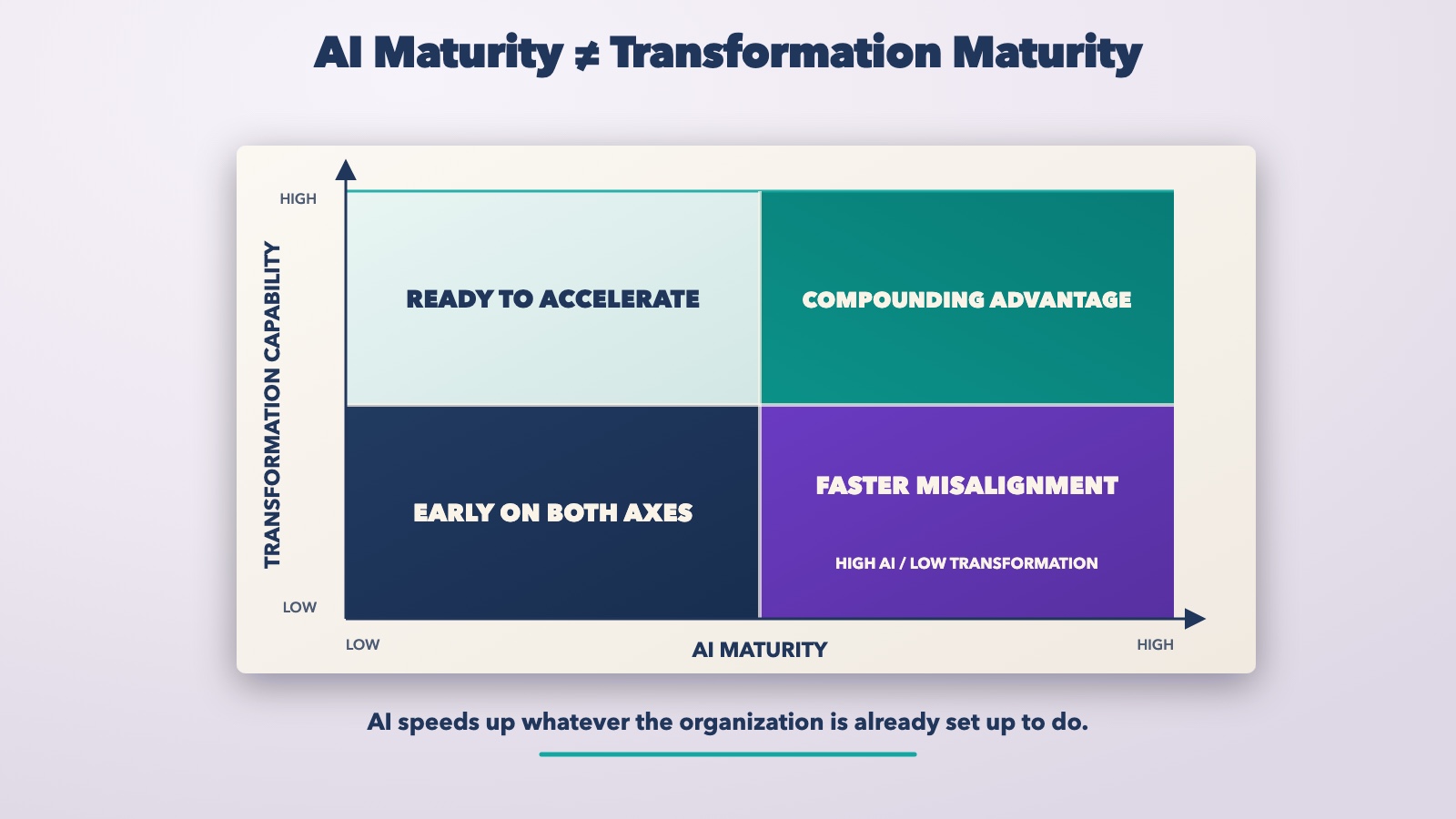
Picture a simple chart with two axes. One measures AI maturity: how far up defined levels (like Every's) the company's teams operate, from occasional one-off tasks to multiple agents embedded in recurring work. The other measures transformation capability; whether the organization can set a clear strategy, lead effectively through change, redesign roles and structures in a manner that honors the company's history and still suits the direction they are headed, build the workforce capabilities it will need, align incentives with what it's trying to achieve, and sustain a culture that supports all of it.
It's easy for an AI roadmap to track only the first axis but to do so is, I believe, dangerous to the point of negligence. Leadership teams count use cases, pilots, agents in production, and hours saved. Those numbers matter, but none of them tells you whether the company is getting better at changing itself, and that is the capability it will need again and again as the technology keeps moving. That is the capability they will need to remain relevant and to grow consistently over time.
A company can be far along the AI axis and still have weak strategy, confused leadership, poor organizational design, outdated workforce capabilities, misaligned incentives, or a dysfunctional culture. And it's understandable because when companies feel like they are behind, they feel the pressure to act. The most obvious and “easiest” action is to buy and implement the technology. But advanced AI use doesn't fix any of the aforementioned issues that result from not addressing the company’s transformation capability, and I think the tool adoption alone is more likely to make those issues more visible and more expensive.
How AI Can Amplify Existing Weaknesses
Consider a hypothetical manufacturer whose sales operations team has moved well up the AI axis. Agents pull customer history, pricing, and capacity data to draft quotes; a recurring workflow follows up on open proposals; a small internal tool flags accounts that haven't placed orders in 90 days. By the measures most AI programs report, this team is a wild success!
Now suppose the sales team is still paid on volume while the company's strategy says it wants to grow margin (common). The agents do what they're asked, faster and at greater scale, so the company produces more discounted quotes than it did before. Suppose, too, that nobody has settled who decides when a quote can exceed standard terms. The agent drafts what it's given, and the disagreement between sales and operations that used to surface in a hallway conversation now surfaces in a customer's inbox.
That's just an illustration, and real cases will be even messier. The pattern is what I'd pay attention to: AI speeds up whatever the organization is already set up to do. I feel like I need to say that again: AI speeds up whatever the organization is already set up to do. When strategy, incentives, decision rights, and roles are aligned, that's a real advantage. When they aren't, the company gets more of the misalignment, delivered faster.
More Capable AI Raises the Stakes on Leadership
There's a second-order effect that I think strengthens the argument. The more powerful AI becomes, the more leadership, organizational design, judgment, and culture matter. As machines take on more of the execution, competitive advantage shifts toward the human and organizational capabilities that decide what should be done, why it should be done, how the systems should be designed, and where accountability should sit.
Every's own guide reflects this in its division of labor, with people supplying context, judgment, and review. My extension is that the same division applies at the level of the entire organization. Someone has to decide which work agents should take on, how roles change around them, what people need to learn, and who owns the outcome when an agent's work goes wrong. Those are leadership and design decisions, and they sit squarely on the transformation axis. They're also why the six human capabilities in The Executive Imperative™ (Judgment, Curiosity, Communication, Courage, Systems Thinking, and Empathy) matter more as AI continues to advance and adoption rates continue to soar.
Transformation capability is harder to measure than AI adoption, and that’s a challenge, which is part of why it gets less attention. You can count agents; it's much harder to count whether a leadership team can redesign a role well or whether incentives are pulling in the same direction as strategy. I'd be wary of anyone who claims to have a precise score for it, but I do think leaders can learn a lot by asking the right questions honestly and building strategies to build successful transformation muscle before prioritizing their AI maturity.
Where to Start
Start with the team that's furthest along in its AI use. Place it on the first axis by identifying how far up the levels its work has moved. Then examine that same work on the second axis:
Does the team's AI usage serve the company's strategy (assuming there is one), or mainly its existing habits?
Who decides what the agents may do, and who owns the result (accountability is key)?
Have roles, structures, and handoffs changed to match the new way of working (and are we committed to training on any new skills required to execute changed roles)?
Do incentives reward the outcomes the strategy calls for (a personal favorite)?
Are people building the capabilities they'll need as the work keeps changing (because it will… keep changing, that is)?
If the strategic answers are weaker than the AI story, you've learned something more useful than another adoption metric. You've found where transformation work needs to happen before more agents make the gap even wider.
The companies that benefit most from AI over time are likely to be the ones that get better at changing themselves, which is a different achievement from getting better at using the tools.